Higher Order Complex Roots
General Rule
-
When we have a complex root in the form \(\sqrt[n]{z}\), where \(n\) is the index of our root and \(z\) is our radicand:
-
If \(n = 8k + 2\), where \(k\) is a positive integer: (\(2\), \(10\), \(18\), \(26\) . . . )
- \(\sqrt[n]{i} = \sqrt{i}\)
- \(\sqrt[n]{-i} = \sqrt{-i}\)
-
If \(n = 8k - 2\): (\(6\), \(14\), \(22\), \(30\) . . . )
- \(\sqrt[n]{i} = \sqrt{-i}\)
- \(\sqrt[n]{-i} = \sqrt{i}\)
-
If \(n = 8k + 4\): (\(4\), \(12\), \(20\), \(28\) . . . )
- \(\sqrt[n]{-1} = \sqrt[4]{-1}\;or\;\sqrt{\pm i}\)
-
If \(n = 4k + 1\): (\(1\), \(5\), \(9\), \(13\) . . . )
- \(\sqrt[n]{i} = i\)
- \(\sqrt[n]{-i} = -i\)
-
If \(n = 4k - 1\): (\(3\), \(7\), \(11\), \(15\) . . . )
- \(\sqrt[n]{i} = -i\)
- \(\sqrt[n]{-i} = i\)
-
If \(n = 4k + 2\): (\(2\), \(6\), \(10\), \(14\) . . . )
- \(\sqrt[n]{-1} = \sqrt[2]{-1}\;or\;\pm i\)
-
Putting this into context
To understand what this means, we can start by looking at our first rule:
-
If \(n = 8k + 2\), where \(k\) is a positive integer: (\(2\), \(10\), \(18\), \(26\) . . . )
- \(\sqrt[n]{i} = \sqrt{i}\)
- \(\sqrt[n]{-i} = \sqrt{-i}\)
Our first expression, \(8k + 2\), gives us all the possible values that this rule works for. Here, the index of our root must be 2 more than a multiple of 8.
Using \(10\) as an example, we can substitute this in for our index \((n)\) above:
- \(\sqrt[10]{i} = \sqrt{i}\)
- \(\sqrt[10]{-i} = \sqrt{-i}\)
In equations, this simply means we can set our goal as \(\sqrt[10]{i}\) and write our solution as \(\sqrt{i}\), so long as we remember to indicate both our goal and solution as \(\frac{\sqrt{2}}{2} + \frac{\sqrt{2}}{2}i\) (one of the values of \(\sqrt{i}\) ).
Again, this works for all values that are \(2\) more than a multiple of \(8\). For example, \(90\) fits this criteria (it's 2 more than 88), so we can set \(\sqrt[90]{i}\) as our goal and solve for \(\sqrt{i}\).
Why indicate?
Just to clarify, \(\sqrt[10]{i}\) and \(\sqrt{i}\) are not the same thing. Rather, we're showing that these values have solutions in common. In order to understand this, it can help if we graph the solutions for both \(\sqrt[10]{i}\) and \(\sqrt{i}\).
![Plotted solutions to \(\sqrt[10]{i}\)](/equations/roots/images/sqrt_10_i.png)
![Plotted solutions to \(\sqrt[2]{i}\)](/equations/roots/images/sqrt_2_i.png)
We can see above that \(\sqrt{i}\) only has 2 solutions, where as \(\sqrt[10]{i}\) has 10 solutions. However, the solutions do match up at 2 values. They both have a solution at \(45^{\circ}\) \((\frac{\sqrt{2}}{2} + \frac{\sqrt{2}}{2}i)\) and \(225^{\circ}\) \((-\frac{\sqrt{2}}{2} - \frac{\sqrt{2}}{2}i)\).
When we indicate our roots, we're showing that this solution is the intended solution of our goal and solution. Otherwise, the principal root (the solution with the smallest angle) is used by default.
Relationship between rules
To help remember some of these rules, let's try to relate them together. For our convenience, they will be rewritten here:
-
If \(n = 8k + 2\):
- \(\sqrt[n]{i} = \sqrt{i}\)
- \(\sqrt[n]{-i} = \sqrt{-i}\)
-
If \(n = 8k - 2\):
- \(\sqrt[n]{i} = \sqrt{-i}\)
- \(\sqrt[n]{-i} = \sqrt{i}\)
-
If \(n = 8k + 4\):
- \(\sqrt[n]{-1} = \sqrt[4]{-1}\;or\;\sqrt{\pm i}\)
-
If \(n = 4k + 1\):
- \(\sqrt[n]{i} = i\)
- \(\sqrt[n]{-i} = -i\)
-
If \(n = 4k - 1\):
- \(\sqrt[n]{i} = -i\)
- \(\sqrt[n]{-i} = i\)
-
If \(n = 4k + 2\):
- \(\sqrt[n]{-1} = \sqrt[2]{-1}\;or\;\pm i\)
We can group our rules into 2 separate categories: multiples of 8 and multiples of 4. To keep things simple, let's start with our multiples of \(8\).
A way to interpret the first two rules in this category \((8k + 2\) and \(8k - 2)\) is to look at the sign of our radicand \((i)\) in our equations. We can see that with our first rule \((8k + 2)\), our radicand keeps its sign throughout both equations, whereas in our second rule \((8k - 2)\), our radicand switches signs.
Because of the upside down variation in equations, this also means there's no functional difference between \(8k + 2\) and \(8k - 2\) in equations. For example, if we want to solve for \(\sqrt{i}\), a goal we can set is \(\sqrt[18]{i}\), since \(18\) is a multiple of \(8k + 2\). However, if a multiple of \(8k + 2\) isn't readily available from the cubes, we can just as easily set the goal as \(\sqrt[14]{i}\) and interpret \(i\) as upside down, since \(14\) is a multiple of \(8k - 2\).
Our third rule, \(8k + 4\), inherits the solutions from the 2 other rules, meaning if you set a goal where the index is a multiple of \(8k + 4\), such as \(\sqrt[4]{-1}\), you can solve for both \(\sqrt{i}\) and \(\sqrt{-i}\). To help digest this, the solutions for all 3 values are plotted below:
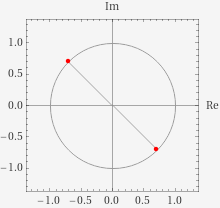
![Plotted solutions to \(\sqrt[4]{-1}\)](/equations/roots/images/sqrt_4_-1.png)
The third rule is more effective when used in the solution rather than the goal. One technique is to set a goal using the first two rules, such as \(\sqrt[94]{i}\), and to solve for \(\sqrt[4]{-1}\) in your solution. Both roots have solutions at \(\frac{\sqrt{2}}{2} - \frac{\sqrt{2}}{2}i\), but the benefit of this technique is that it only requires one \(i\) cube. This is useful when only one \(i\) cube is rolled, or if you want to throw all the \(i\) cubes into forbidden to confuse your opponent.
With our multiples of \(4\), we can apply the same patterns above. Again, with our first rule \((4k + 1)\), our radicand keeps its sign, in our second rule \((4k - 1)\), our radicand switches signs, and with our third rule \((4k + 2)\), we inherit the solutions from the 2 other rules.
Setting goals
Keep in mind that if our goal is based off a multiple of \(4k + 1\) or \(4k - 1\), a clever enough opponent could guess the goal without using the rule. For example, if you set your goal as \(\sqrt[93]{i}\) (a multiple of \(4k + 1\)), your opponent could work out that \(i^{93} = i\) and use this to determine \(\sqrt[93]{i} = i\). In fact, because of how easy it is to guess the solutions for our multiple of \(4\) goals, it's suggested to not use these goals without also using variations that complicate the shake (we'll explore this idea in the variations section).
On the other hand, a goal like \(\sqrt[98]{i}\) (a multiple of \(8k + 2\)) requires your opponent to come up with \(\sqrt{i}\) as an answer. Likewise, a goal like \(\sqrt[70]{i}\) (a multiple of \(8k - 2\)) requires your opponent to come up with the even crazier \(\sqrt{-i}\). Goals based off of multiples of 8 much more robust because of this.
To add on to this, we can also use the earlier mentioned technique of throwing all the \(i\) cubes into forbidden. If our index is a multiple of \(8k + 2\) or \(8k - 2\), this forces the simpliest solution to be \(\sqrt[4]{-1}\), which is extremely difficult to come up with as an opponent.
Solving strategy
As for actually solving these goals, we'll explore two ways to go about this.
The first method we'll review is rather pedantic, but will translate nicely for when we review strategies involving variations. In this method, we reduce the index of our root by multiples of \(4\) to see if we end up with a remainder of \(1\), \(2\), or \(3\) (or if you reduce into the negatives, \(-1\), \(-2\), and \(-3\)). If that fails to produce an answer, we reduce our index by multiples of \(8\) to see if we end up with a remainder of \(2\), \(4\), or \(6\) (or \(-2\), \(-4\) and \(-6\)).
Here's a chart listing each remainder and their corresponding rule:
-
When reducing by multiples of 4:
- Remainder of \(1\) or \(-3\): \(4k + 1\)
- Remainder of \(2\) or \(-2\): \(4k + 2\)
- Remainder of \(3\) or \(-1\): \(4k - 1\)
-
When reducing by multiples of 8:
- Remainder of \(2\) or \(-6\): \(8k + 2\)
- Remainder of \(4\) or \(-4\): \(8k + 4\)
- Remainder of \(6\) or \(-2\): \(8k - 2\)
As an example, let's try to solve the goal \(\sqrt[86]{i}\). We'll first reduce the index (\(86\)) by a multiple of \(4\), which nets us a remainder of \(2\) (or \(-2\)). On the chart above, this corresponds with the \(4k + 2\) rule. However, our rule for \(4k + 2\) is only defined for a radicand of \(-1\), so we'll continue by reducing our index by multiples of \(8\). Reducing \(86\) by a multiple of \(8\) gives us a remainder of \(6\) (or \(-2\)), which corresponds with the \(8k - 2\) rule on the chart above. From our general rule, this means we can solve for \(\sqrt{i}\), or if you interpret the \(i\) in the goal as upside down, we can solve for \(\sqrt{-i}\).
The second method we'll review is arguably identical to the first method, so you can simply imagine it as a different way to do the first method. Instead of reducing the index by multiples of \(4\) and \(8\), we instead find the nearest multiple of \(4\) and \(8\) to our index and calculate the difference between our index and that multiple. This difference is going to act as our remainder.
Going back to the \(\sqrt[86]{i}\) problem, the nearest multiple of \(4\) to \(86\) is \(84\). The difference between \(86\) and \(84\) is \(2\), so our remainder is \(2\) here. Since a remainder of \(2\) paired with a radicand of \(i\) doesn't fit any of our general rules, we move on by finding the nearest multiple of \(8\), which is \(88\). The difference between \(86\) and \(88\) is \(-2\) (be careful with the sign here, \(86\) is 2 less than a multiple of \(8\)), which corresponds on our chart to \(8k - 2\).
If it wasn't already clear, "nearest multiple" is a very loose term here. For \(86\), we could've chosen our nearest multiple of \(8\) to be \(80\), which would net us a remainder of \(6\). Nevertheless, this still corresponds to the \(8k - 2\) rule on the chart.
There are of course some ways to optimize this strategy. Since our rules of \(8k + 4\) and \(4k + 2\) aren't defined when our radicand is \(i\), we don't have to check for these rules when our radicand is \(i\). Likewise, when our radicand is \(-1\), we only have to check the \(8k + 4\) and \(4k + 2\) rules. We do have to be careful when our radicand is \(-1\) however. Although \(\sqrt[19]{-1}\) doesn't fit any of our rules, \(-1\) raised to any odd power is still \(-1\), so a solution to the root above would be \(-1\).
Using the information above, here's a table listing the first \(50\) roots of \(i\) and \(-1\) as well as their corresponding rule.
| \( 8k + 2 \) | \( 8k - 2 \) | \( 4k + 1 \) | \( 4k - 1 \) | |
|---|---|---|---|---|
| \( 0 \) | ||||
| \( 1 \) | \( i \) | |||
| \( 2 \) | \( \sqrt{i} \) | |||
| \( 3 \) | \( -i \) | |||
| \( 4 \) | ||||
| \( 5 \) | \( i \) | |||
| \( 6 \) | \( \sqrt{-i} \) | |||
| \( 7 \) | \( -i \) | |||
| \( 8 \) | ||||
| \( 9 \) | \( i \) | |||
| \( 10 \) | \( \sqrt{i} \) | |||
| \( 11 \) | \( -i \) | |||
| \( 12 \) | ||||
| \( 13 \) | \( i \) | |||
| \( 14 \) | \( \sqrt{-i} \) | |||
| \( 15 \) | \( -i \) | |||
| \( 16 \) | ||||
| \( 17 \) | \( i \) | |||
| \( 18 \) | \( \sqrt{i} \) | |||
| \( 19 \) | \( -i \) | |||
| \( 20 \) | ||||
| \( 21 \) | \( i \) | |||
| \( 22 \) | \( \sqrt{-i} \) | |||
| \( 23 \) | \( -i \) | |||
| \( 24 \) | ||||
| \( 25 \) | \( i \) | |||
| \( 26 \) | \( \sqrt{i} \) | |||
| \( 27 \) | \( -i \) | |||
| \( 28 \) | ||||
| \( 29 \) | \( i \) | |||
| \( 30 \) | \( \sqrt{-i} \) | |||
| \( 31 \) | \( -i \) | |||
| \( 32 \) | ||||
| \( 33 \) | \( i \) | |||
| \( 34 \) | \( \sqrt{i} \) | |||
| \( 35 \) | \( -i \) | |||
| \( 36 \) | ||||
| \( 37 \) | \( i \) | |||
| \( 38 \) | \( \sqrt{-i} \) | |||
| \( 39 \) | \( -i \) | |||
| \( 40 \) | ||||
| \( 41 \) | \( i \) | |||
| \( 42 \) | \( \sqrt{i} \) | |||
| \( 43 \) | \( -i \) | |||
| \( 44 \) | ||||
| \( 45 \) | \( i \) | |||
| \( 46 \) | \( \sqrt{-i} \) | |||
| \( 47 \) | \( -i \) | |||
| \( 48 \) | ||||
| \( 49 \) | \( i \) | |||
| \( 50 \) | \( \sqrt{i} \) | |||
| \( 51 \) | \( -i \) | |||
| \( 52 \) | ||||
| \( 53 \) | \( i \) | |||
| \( 54 \) | \( \sqrt{-i} \) | |||
| \( 55 \) | \( -i \) | |||
| \( 56 \) | ||||
| \( 57 \) | \( i \) | |||
| \( 58 \) | \( \sqrt{i} \) | |||
| \( 59 \) | \( -i \) | |||
| \( 60 \) | ||||
| \( 61 \) | \( i \) | |||
| \( 62 \) | \( \sqrt{-i} \) | |||
| \( 63 \) | \( -i \) | |||
| \( 64 \) | ||||
| \( 65 \) | \( i \) | |||
| \( 66 \) | \( \sqrt{i} \) | |||
| \( 67 \) | \( -i \) | |||
| \( 68 \) | ||||
| \( 69 \) | \( i \) | |||
| \( 70 \) | \( \sqrt{-i} \) | |||
| \( 71 \) | \( -i \) | |||
| \( 72 \) | ||||
| \( 73 \) | \( i \) | |||
| \( 74 \) | \( \sqrt{i} \) | |||
| \( 75 \) | \( -i \) | |||
| \( 76 \) | ||||
| \( 77 \) | \( i \) | |||
| \( 78 \) | \( \sqrt{-i} \) | |||
| \( 79 \) | \( -i \) | |||
| \( 80 \) | ||||
| \( 81 \) | \( i \) | |||
| \( 82 \) | \( \sqrt{i} \) | |||
| \( 83 \) | \( -i \) | |||
| \( 84 \) | ||||
| \( 85 \) | \( i \) | |||
| \( 86 \) | \( \sqrt{-i} \) | |||
| \( 87 \) | \( -i \) | |||
| \( 88 \) | ||||
| \( 89 \) | \( i \) | |||
| \( 90 \) | \( \sqrt{i} \) | |||
| \( 91 \) | \( -i \) | |||
| \( 92 \) | ||||
| \( 93 \) | \( i \) | |||
| \( 94 \) | \( \sqrt{-i} \) | |||
| \( 95 \) | \( -i \) | |||
| \( 96 \) | ||||
| \( 97 \) | \( i \) | |||
| \( 98 \) | \( \sqrt{i} \) | |||
| \( 99 \) | \( -i \) | |||
| \( 100 \) |
| \( 8k + 4 \) | \( 4k + 2 \) | \( 2k + 1 \) | |
|---|---|---|---|
| \( 0 \) | |||
| \( 1 \) | \( -1 \) | ||
| \( 2 \) | \( \pm i \) | ||
| \( 3 \) | \( -1 \) | ||
| \( 4 \) | \( \sqrt{\pm i} \) | ||
| \( 5 \) | \( -1 \) | ||
| \( 6 \) | \( \pm i \) | ||
| \( 7 \) | \( -1 \) | ||
| \( 8 \) | |||
| \( 9 \) | \( -1 \) | ||
| \( 10 \) | \( \pm i \) | ||
| \( 11 \) | \( -1 \) | ||
| \( 12 \) | \( \sqrt{\pm i} \) | ||
| \( 13 \) | \( -1 \) | ||
| \( 14 \) | \( \pm i \) | ||
| \( 15 \) | \( -1 \) | ||
| \( 16 \) | |||
| \( 17 \) | \( -1 \) | ||
| \( 18 \) | \( \pm i \) | ||
| \( 19 \) | \( -1 \) | ||
| \( 20 \) | \( \sqrt{\pm i} \) | ||
| \( 21 \) | \( -1 \) | ||
| \( 22 \) | \( \pm i \) | ||
| \( 23 \) | \( -1 \) | ||
| \( 24 \) | |||
| \( 25 \) | \( -1 \) | ||
| \( 26 \) | \( \pm i \) | ||
| \( 27 \) | \( -1 \) | ||
| \( 28 \) | \( \sqrt{\pm i} \) | ||
| \( 29 \) | \( -1 \) | ||
| \( 30 \) | \( \pm i \) | ||
| \( 31 \) | \( -1 \) | ||
| \( 32 \) | |||
| \( 33 \) | \( -1 \) | ||
| \( 34 \) | \( \pm i \) | ||
| \( 35 \) | \( -1 \) | ||
| \( 36 \) | \( \sqrt{\pm i} \) | ||
| \( 37 \) | \( -1 \) | ||
| \( 38 \) | \( \pm i \) | ||
| \( 39 \) | \( -1 \) | ||
| \( 40 \) | |||
| \( 41 \) | \( -1 \) | ||
| \( 42 \) | \( \pm i \) | ||
| \( 43 \) | \( -1 \) | ||
| \( 44 \) | \( \sqrt{\pm i} \) | ||
| \( 45 \) | \( -1 \) | ||
| \( 46 \) | \( \pm i \) | ||
| \( 47 \) | \( -1 \) | ||
| \( 48 \) | |||
| \( 49 \) | \( -1 \) | ||
| \( 50 \) | \( \pm i \) | ||
| \( 51 \) | \( -1 \) | ||
| \( 52 \) | \( \sqrt{\pm i} \) | ||
| \( 53 \) | \( -1 \) | ||
| \( 54 \) | \( \pm i \) | ||
| \( 55 \) | \( -1 \) | ||
| \( 56 \) | |||
| \( 57 \) | \( -1 \) | ||
| \( 58 \) | \( \pm i \) | ||
| \( 59 \) | \( -1 \) | ||
| \( 60 \) | \( \sqrt{\pm i} \) | ||
| \( 61 \) | \( -1 \) | ||
| \( 62 \) | \( \pm i \) | ||
| \( 63 \) | \( -1 \) | ||
| \( 64 \) | |||
| \( 65 \) | \( -1 \) | ||
| \( 66 \) | \( \pm i \) | ||
| \( 67 \) | \( -1 \) | ||
| \( 68 \) | \( \sqrt{\pm i} \) | ||
| \( 69 \) | \( -1 \) | ||
| \( 70 \) | \( \pm i \) | ||
| \( 71 \) | \( -1 \) | ||
| \( 72 \) | |||
| \( 73 \) | \( -1 \) | ||
| \( 74 \) | \( \pm i \) | ||
| \( 75 \) | \( -1 \) | ||
| \( 76 \) | \( \sqrt{\pm i} \) | ||
| \( 77 \) | \( -1 \) | ||
| \( 78 \) | \( \pm i \) | ||
| \( 79 \) | \( -1 \) | ||
| \( 80 \) | |||
| \( 81 \) | \( -1 \) | ||
| \( 82 \) | \( \pm i \) | ||
| \( 83 \) | \( -1 \) | ||
| \( 84 \) | \( \sqrt{\pm i} \) | ||
| \( 85 \) | \( -1 \) | ||
| \( 86 \) | \( \pm i \) | ||
| \( 87 \) | \( -1 \) | ||
| \( 88 \) | |||
| \( 89 \) | \( -1 \) | ||
| \( 90 \) | \( \pm i \) | ||
| \( 91 \) | \( -1 \) | ||
| \( 92 \) | \( \sqrt{\pm i} \) | ||
| \( 93 \) | \( -1 \) | ||
| \( 94 \) | \( \pm i \) | ||
| \( 95 \) | \( -1 \) | ||
| \( 96 \) | |||
| \( 97 \) | \( -1 \) | ||
| \( 98 \) | \( \pm i \) | ||
| \( 99 \) | \( -1 \) | ||
| \( 100 \) | \( \sqrt{\pm i} \) |
Hopefully, you've noticed that roots of \(i\) don't contain solutions at exact multiples of \(4\), and that roots of \(-1\) don't have solutions at multiples of \(8\). We'll explore this idea in more depth when we look into variations.
Negative indexes
Before moving onto variations however, the last thing we need to cover is understanding how negative indexes work. Simply put, \(\sqrt[-n]{i} = \sqrt[n]{-i}\). A goal of \(\sqrt[-70]{i}\) can be rewritten as \(\sqrt[70]{-i}\), which simplifies to \(\sqrt{i}\). Here are some ways to achieve this goal in \(6\) cubes.
- \((2-72)\sqrt{i}\)
- \((5\times14)\sqrt{i}\) (upside down 5)
Interplay with variations
Some variations can bring even more complexity to this already elaborate strategy. Due to how robust the main strategy is, it's best to try and reserve these strategies for very high level play.
Wild — Impact:
This variation doesn't open up any unique strategies. There isn't any meaningful way to fit a wild cube into the goal, but it can be useful if you're missing a necessary cube for your solution.
Powers of the Base — Impact:
This variation does open up a unique strategy. Here, we're going to use the idea that when our index \((n)\) is a multiple of \(4\), \(\sqrt[n]{i}\) has no trivial solutions. Here's a goal that uses this strategy:
- \((63+1)\sqrt{i}\)
The idea is to set a goal with the index in the form some number \(+1\) or \(- 1\), so that when you compute the index, you get a multiple of \(4\) (in this case, \(64\)). By default this goal has no trivial solutions, but we can use Powers of the Base to modify the index.
Assuming our base is still \(10\), let's interpret the \(1\) as \(10^{1}\). Our goal becomes \((63+10)\sqrt{i}\), or \(\sqrt[73]{i}\). This new index falls into \(4k + 1\), so our goal simply reduces to \(i\).
Although usually not necessary, we can also rewrite the \(1\) with higher powers of \(10\) to give alternate answers. Interpreting the \(1\) as \(10^{2}\), or \(100\), gives us \((63+100)\sqrt{i}\), which becomes \(\sqrt[163]{i}\) and reduces to \(-i\) (multiple of \(4k - 1\)). In most cases (such as this one), higher powers will only change the sign of the goal.
If Base is called, remember that our base in Powers of the Base must reflect the new base. For example, if Base \(11\) is called, \(1\) must be interpreted as \(11^{n}\) instead of \(10^{n}\). Our original goal, \((63+1)\sqrt{i}\), can be interpreted as \((63+11)\sqrt{i}\), or \(\sqrt[74]{i}\). This reduces down to \(\sqrt{i}\) (multiple of \(8k + 2\)).
Base M — Impact:
This variation doesn't open up any unique strategies, but it will require you to play more carefully.
Before solving the goal, make sure you convert your indexes first. With Base \(12\), a goal like \(\sqrt[76]{i}\) converts to \(\sqrt[90]{i}\), which reduces down to \(\sqrt{i}\) (multiple of \(8k + 2\)).
If for some reason, Decimal is called with Base \(12\), be wary that \(3\) cube numerals are now allowed, and that the \(\sqrt{\;\;}\) cube can be interpreted as the digit \(11\). An attentive opponent could interpret \(\sqrt[76]{i}\) as \(1091i\) \((7 \times 144 + 6 \times 12 + 11)\), which, although is still difficult to solve, it's best to stifle any alternate interpretations. To avoid this, set the index as its own expression and separate it from the root using parenthesis:
- \((79-3)\sqrt{i}\)
- \((19\times4)\sqrt{i}\)
And of course, always be careful to not use digits that are equal to or higher than the Base. Don't use an \(8\) cube if Base \(8\) is called.
Multiple of K — Impact:
This variation doesn't open up any unique strategies. Just be mindful to add or subtract \(k\) at the end of your solution.
Multiple Operations — Impact:
This variation doesn't open up any unique strategies. Similar to wild, it can be useful if you're missing a necessary cube for your solution. Be mindful that with Multiple Operations, the \(-\) cube cannot be used multiple times to represent \(i\).
Factorial — Impact:
This variation opens the door to my favorite strategy. We're going to use the idea that any number \(n\) factorial will always be a multiple \(4\) and \(8\) (given that \(n\ge4\)). Here's a quick explanation:
Take \(51!\) for example. Using the definition of factorial, we can rewrite \(51!\) as \(51\times50\times49\:\times\;.\;.\;.\times\:4\times3\times2\). Since \(4\times2 = 8\), this means \(8\) (and 4) must be a factor of \(51!\), and that likewise, \(51!\) must be a multiple of \(4\) and \(8\).
Now, let's set a goal where our index computes to a multiple of \(4\):
- \((62+2)\sqrt{i}\)
We're going to insert the factorial behind the \(62\). Since \(62!\) is a multiple of \(8\), this goal falls into the \(8k + 2\) pattern, meaning that it reduces to \(\sqrt{i}\).
Heres a list of some possible goals you can set with this variation and their corresponding rule. You might find this list to be closely related to the remainder chart from an earlier section:
- \(8k + 2\): \((n!+2)\sqrt{i}\) or \((n!-6)\sqrt{i}\)
- \(8k - 2\): \((n!+6)\sqrt{i}\) or \((n!-2)\sqrt{i}\)
- \(8k + 4\): \((n!\pm4)\sqrt{-1}\)
- \(4k + 1\): \((n!+1)\sqrt{i}\) or \((n!-3)\sqrt{i}\)
- \(4k - 1\): \((n!-1)\sqrt{i}\) or \((n!+3)\sqrt{i}\)
- \(4k + 2\): \((n!\pm2)\sqrt{-1}\)
Number of Factors — Impact:
This variation doesn't open up any unique strategies.
Exponent — Impact:
This variation sets the stage for the most powerful strategy in this article. We're going to utilize the idea that in order to solve our roots, we reduce our index by multiples of \(4\) and \(8\) to find our remainder. Here's an example of the setup of our goal:
- \((77 - 5)\sqrt{i}\) (black exponent called, 7 cubes are block)
Again, we want the index of our goal to compute to a multiple of 4 by default. However, because black exponent is called, let's interpret the goal as \((7^{7} - 5)\sqrt{i}\). Now it's time to solve the expression. To restate the solving process above, we reduce the index by \(4\) and \(8\) to find the remainder. Well, here our index is an exponential expression, and the way we find the remainder of an exponential expression is... cycling.
To pull this off, we start by cycling the exponent \((7^{7})\). Usually, you'll want to cycle with a multiple of \(8\) with this strategy. That being said, here's the cycle for \(7^{7}\) mod \(8\):
- \(7^1 = 7\)
- \(7^2 = 49\) mod \(8 ≡ 1\)
Our cycle length is \(2\), so once we reduce our exponent, we get \(7^7 ≡ 7\).
Now we can substitute everything back into our index. \((7^{7} - 5)\sqrt{i}\) \(=\) \((7 - 5)\sqrt{i}\) \(=\) \(\sqrt[2]{i}\). We can effectively solve for \(\sqrt{i}\).
The reason we cycle with \(8\) first is because we're technically cycling by \(4\) at the same time (\(8\) is a multiple of \(4\)). Alternatively, if you can predict that your index will be an odd number, you might get your answer faster if you cycle with \(4\) instead. (This is because \(4k \pm 1\) is always odd, whereas \(8k \pm 2\) is always even).
As powerful as this strategy is, the only way to force our opponents to use it is to set our index as a multiple of \(4\). Otherwise, the general rule can be used to solve the goal instead. If we want to force this strategy for all indexes, one technique is to make our first cube be upside down:
- \((39-2)\sqrt{i}\) (upside down \(3\))
Because of the upside down \(3\), our opponent has to interpret the goal as \(((-3)^{9}-2)\sqrt{i}\). Let's solve this quickly. We'll cycle with a multiple of \(8\) for demonstration purposes (but because our index is odd here, cycling with a multiple of \(4\) would also yield the same answer). Cycling \((-3)^{9}\) with a \(k\) of \(8\):
- \((-3)^1 = -3\)
- \((-3)^2 = 9\) mod \(8 ≡ 1\)
Our cycle length is \(2\) again, so once we reduce our exponent, we get \((-3)^9 ≡ -3\).
Substituting everything back in again: \(((-3)^{9} - 2)\sqrt{i}\) \(=\) \((-3 - 2)\sqrt{i}\) \(=\) \(\sqrt[-5]{i}\) \(=\) \(\sqrt[5]{-i}\) (In that last step, remember our rule for negative indexes). Our index, \(5\), is a multiple of \(4k + 1\), so our root reduces down to \(-i\).
Decimal — Impact:
*More development needed
Log — Impact:
This variation doesn't open up any unique strategies.
Practice
\(\sqrt[18]{i}\) shares solutions with which of the following?
- A\(i\)
- B\(-i\)
- C\(\sqrt{i}\)
- D\(\sqrt{-i}\)
Our index, \(18\), falls into the \(8k + 2\) pattern (it's \(2\) more than \(16\)). Our rule for \(n = 8k + 2\) is as follows:
- \(\sqrt[n]{i} = \sqrt{i}\)
- \(\sqrt[n]{-i} = \sqrt{-i}\)
The radicand under our root is \(i\), so our problem falls under the first equation: \(\sqrt[n]{i} = \sqrt{i}\)
Therefore, \(\sqrt[18]{i}\) shares solutions with \(\sqrt{i}\).
Given the goal below:
What are the possible solutions to this goal?
- A\(i\)
- B\(-i\)
- C\(\sqrt{i}\)
- D\(\sqrt{-i}\)
- ENone of the above
The goal above can be read as \(\sqrt[62]{i}\).
Our index, \(62\), falls into the \(8k - 2\) pattern (it's \(2\) less than \(64\)). Our rule for \(n = 8k - 2\) is as follows:
- \(\sqrt[n]{i} = \sqrt{-i}\)
- \(\sqrt[n]{-i} = \sqrt{i}\)
However, because \(i\), when used in the goal, is ambiguous as to whether it is right side up or upside down, we can interpret our goal as both \(\sqrt[62]{i}\) and \(\sqrt[62]{-i}\).
Interpreting the goal as \(\sqrt[62]{i}\) gives us a solution of \(\sqrt{-i}\), whereas interpreting the goal as \(\sqrt[62]{-i}\) gives us a solution of \(\sqrt{i}\).
In conclusion, our correct answer choices are \(\sqrt{i}\) and \(\sqrt{-i}\).